

Overview
Assumptions
- The pool is the original source for all x-tokens: it is assumed that the pool is the only source for originally getting x-tokens. Other markets such as constant-product AMMs can be used once the tokens are in circulation, but all tokens are originally purchased from the TBC.
- The pool has been deployed through the factory: The factory automatically grants ownership of the pool to the deployer address. It also emits an event for the monitoring services to know when a pool has been deployed through it.
Ownership
The owner of the pool is granted initially to the deployer address. The pool uses theOwnable contract from OpenZeppelin. Therefore, transfer of ownership is always allowed to the current owner of the pool.
ALTBC Price Curve
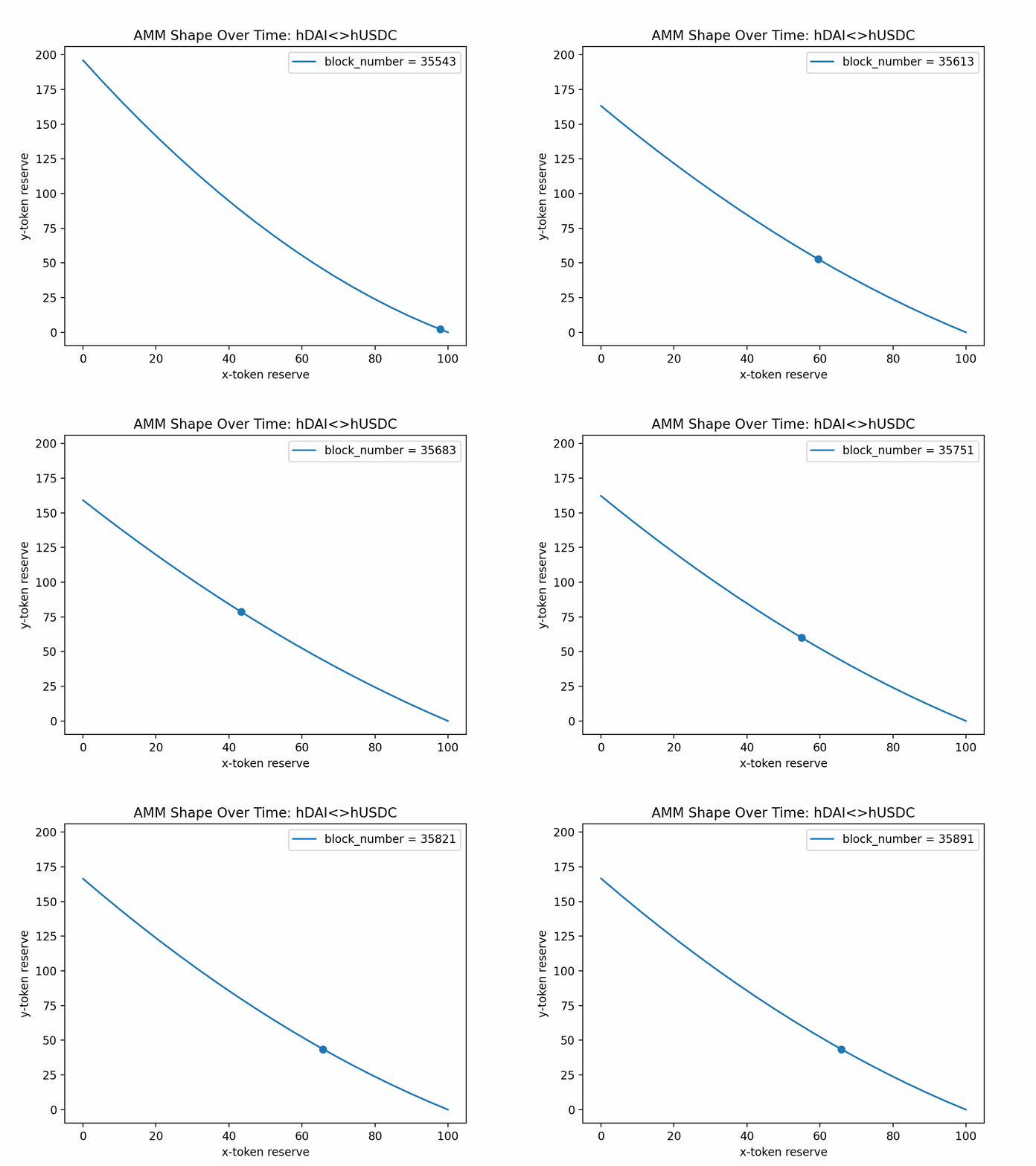
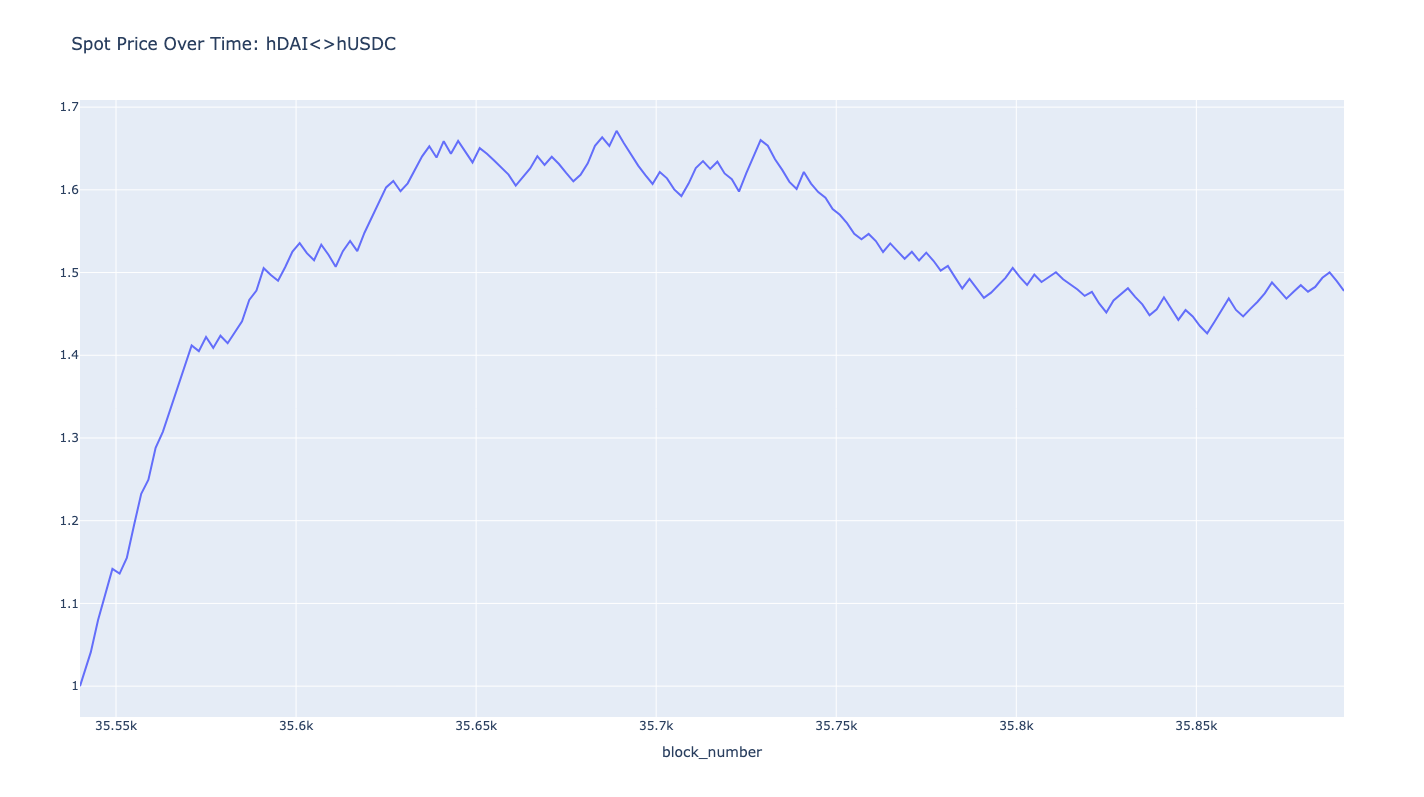
The price curve of an ALTBC pool obeys what we call an adjustable linear token bonding curve. For an individual transaction, the price is calculated according to a linear formula. After each transaction, the line that defines the price is updated. The slope of this line changes based on the amount of x-tokens out in circulation. The effective price curve (how the price evolves over time, across many swaps) will be a concave curve that tends to stabilize the more tokens are sold.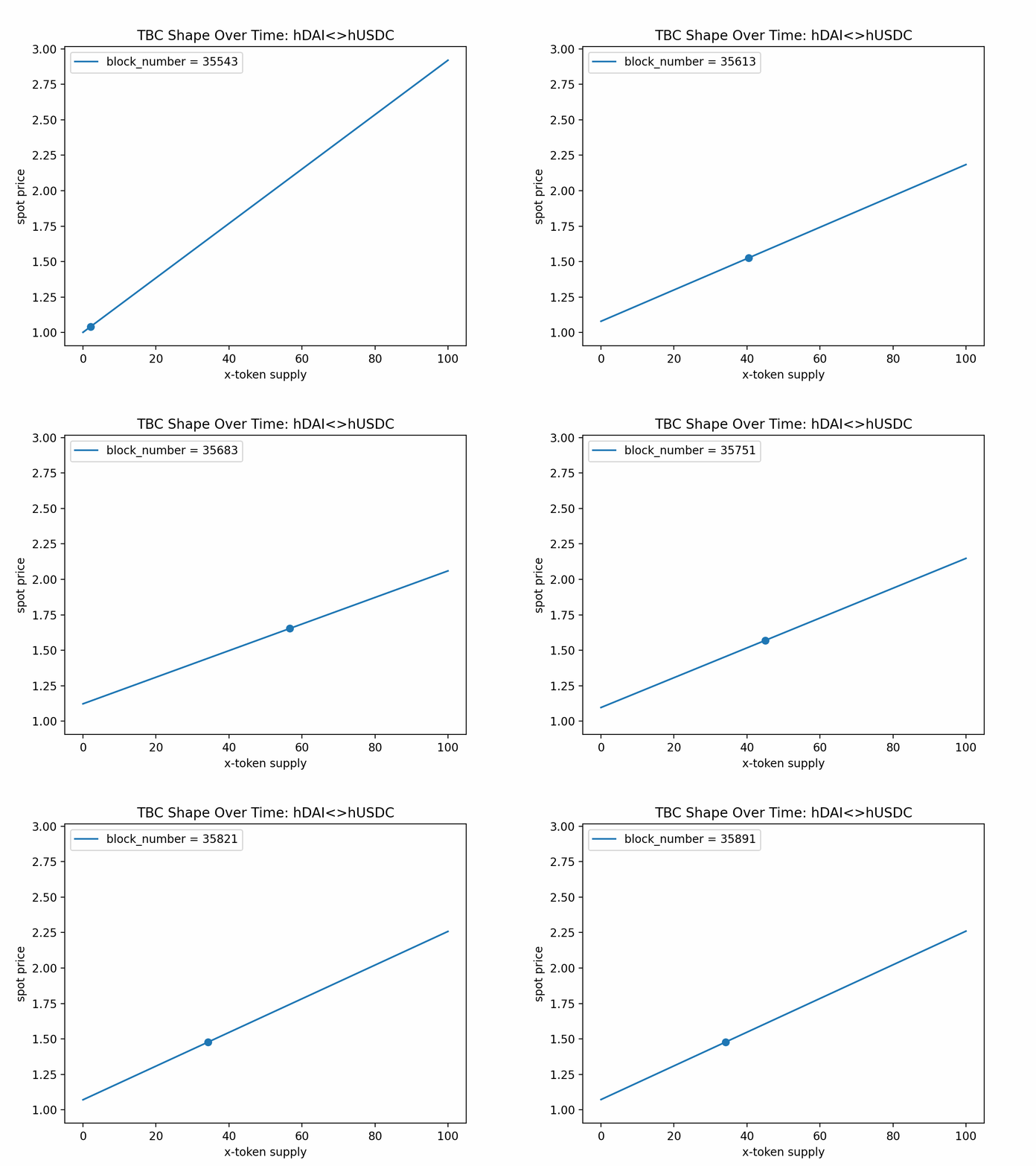
Access Control
Owner
The owner of the pool contract is the only one who can execute the following privileged functions:- enableSwaps(bool _enable)
- setLPFee(uint16 _fee)
- addXSupply(uint256 _amount)
- collectLPFees()
- withdrawRevenue()
Protocol Fee Collector
The protocol fee collector account of the pool contract is the only one who can execute the following privileged functions:- setProtocolFee(uint16 _fee)
- proposeProtocolFeeCollector()
proposeProtocolFeeCollector, and the only function that this transitionary role can call is:
- confirmProtocolFeeCollector()
Security
The pool can be paused at any point by the owner account which means that all trading is disabled.Revenue
As a consequence of the mathematical design, the pool will generate a small revenue per trade, independently of any fees set on the pool. The size of this revenue is correlated with the size ofxMin, and grows over time with each trade. This revenue can be collected by the pool owner. Note that there may be remaining dust in the pool which will only be extracted when the pool is closed.
Artificial Price Manipulation Control
The mathematical design of this pool is such that it would be possible to artificially increase the price of an asset at no cost if we allowedx to be zero. At low values of x, it is also possible to increase the price of the asset at a potentially low cost by wash trading.
To mitigate this possible price manipulation, the pool initiates with a synthetic trade. The amount of this synthetic trade is defined as xMin + w and is stored in the contract as xMax, where w is the initial xTokens added to the pool expressed in a packedFloat format.
Virtual Liquidity
This synthetic trade will cause the pool to have a virtual liquidity which is stored in the contract aswActive which is the difference between w and wInactive. This synthetic trade will also generate revenue for the pool which will be accumulated as dust in the pool.
Usage
Deployment
To deploy a pool please follow the guidelines in the factory guideline.Initialization
After deployment, it is necessary to do the following step:- Add liquidity to the pool (see Managing Liquidity). Notice that initial liquidity is only necessary for the x-token since the y-token will be provided through swaps by users. The amount of liquidity provided will be equal to the totalSupply of the token.
Managing Fees
LP Fees
The liquidity-provider fees are a portion of the swap that would go towards the liquidity provider as a compensation for the service provided. In this pool, there can only be one liquidity provider who is the owner of the pool, and therefore, the liquidity-provider fees can be managed only by the owner of the contract. Here are the main features of the fees of the pool:- Fees can be updated at any time.
- Fees can be 0.
- Fees are expressed in basis points.
- Fees can be 50% - protocol fees.
- Fees are collected in the y-token.
- Fees are kept inside the pool.
- Fees can be collected by the owner of the NFT token ID that defines the position of the liquidity provider.
Protocol Fees
Protocol fees are a portion of each swap that will go towards the protocol as a compensation for its service provided. The management of the protocol fees is under complete control of the protocol and not of the owner of the pool. The following are the properties of the pool’s protocol fees:- Protocol fees can be updated at any time.
- Protocol fees can be 0.
- Protocol fees are expressed in basis points.
- Protocol fees can be as high as 0.20%.
- Protocol fees are collected in the y-token.
- Protocol fees are kept inside the pool.
- Protocol fees need a manual withdrawal by the protocol fee collector who then will receive the totality of the fees accumulated.
Protocol fee value
The protocol fee value can be set at any time only by the protocol fee collector account. The following functions are available to manage this value:Protocol fee collector
The protocol fee collector account of the pool can be updated at any time. Only the protocol fee collector account can update this value. The following functions are available to manage this address:- The current protocol fee collector account proposes a new protocol fee collector address through the function
proposeProtocolFeeCollector. - The proposed protocol fee collector account then needs to call the
confirmProtocolFeeCollectorfunction to accept/confirm this role.
Revenue
Because of the mechanism to deter artificial price increase in a fresh pool, a synthetic trade is done when deploying a new pool. This new pool will start with itsx at xMin. Therefore, the outstanding liquidity will always be x - xMin. This dust is accessible through the withdrawRevenue function, callable by the owner of the NFT token ID that defines the position of the liquidity provider.
Managing Swaps
Swaps can be enabled and disabled. This functionality uses the standardPausable contract found in projects like OpenZeppelin. To enable or disable swaps, use the following function:
- swap()
Swaps
The main feature of the pool is that it allows swaps. Swaps are permissionless meaning that anybody can use this feature. A vital factor of a swap is price, for which there are three different functions that can be used. These functions will be explained in the following sections.Spot price
In the context of a TBC AMM, spot price refers to the current price for buying 1 full token assuming a flat price for the whole token (no price difference between the first wei and the last wei of the purchased token).Swap simulations
The pool offers two ways of simulating a swap to know either how much is needed to get a certain amount of tokens out of the pool (the output is known and the input is requested), or to know how much is going to be obtained from a swap after a certain amount of tokens are provided to the pool (the input is known and the output is requested). This is useful since this lets the user know the actual cost of a swap, and it can also give the user a point of reference to tell the pool how to calculate the slippage of the swap (in reality, the frontend usually handles this last step). To simulate a swap, these two functions are available:lpFeeAmount and the protocolFeeAmount values which are returned alongside the amountIn/amountOut (main returned value). These values are only informational as they have already been factored in the main returned value. Therefore, there is no need to carry out any addition/subtraction to use the amountIn/amountOut in the swap function.